SEC NIL Money: The 20 Highest-Valued Players in the Conference for 2026
From multimillion-dollar quarterbacks to elite basketball talent, the SEC's NIL marketplace shows just how much money is flowing into college athletics.
The money in college sports has reached another level, and the Southeastern Conference is at the center of the conversation.
From football quarterbacks commanding multimillion-dollar valuations to basketball players attracting major financial commitments, NIL has become a critical part of how SEC programs compete for talent. But figuring out exactly who makes the most money is more complicated than it might appear.
A player's reported NIL valuation is not necessarily the amount deposited into that athlete's bank account. Most contracts remain private, and public estimates can combine market projections, reported agreements and assessments of an athlete's earning potential.
With that distinction in mind, here is a look at 20 of the SEC's highest-valued athletes based on The Sideline's published 2026 NIL estimates, updated October 26.
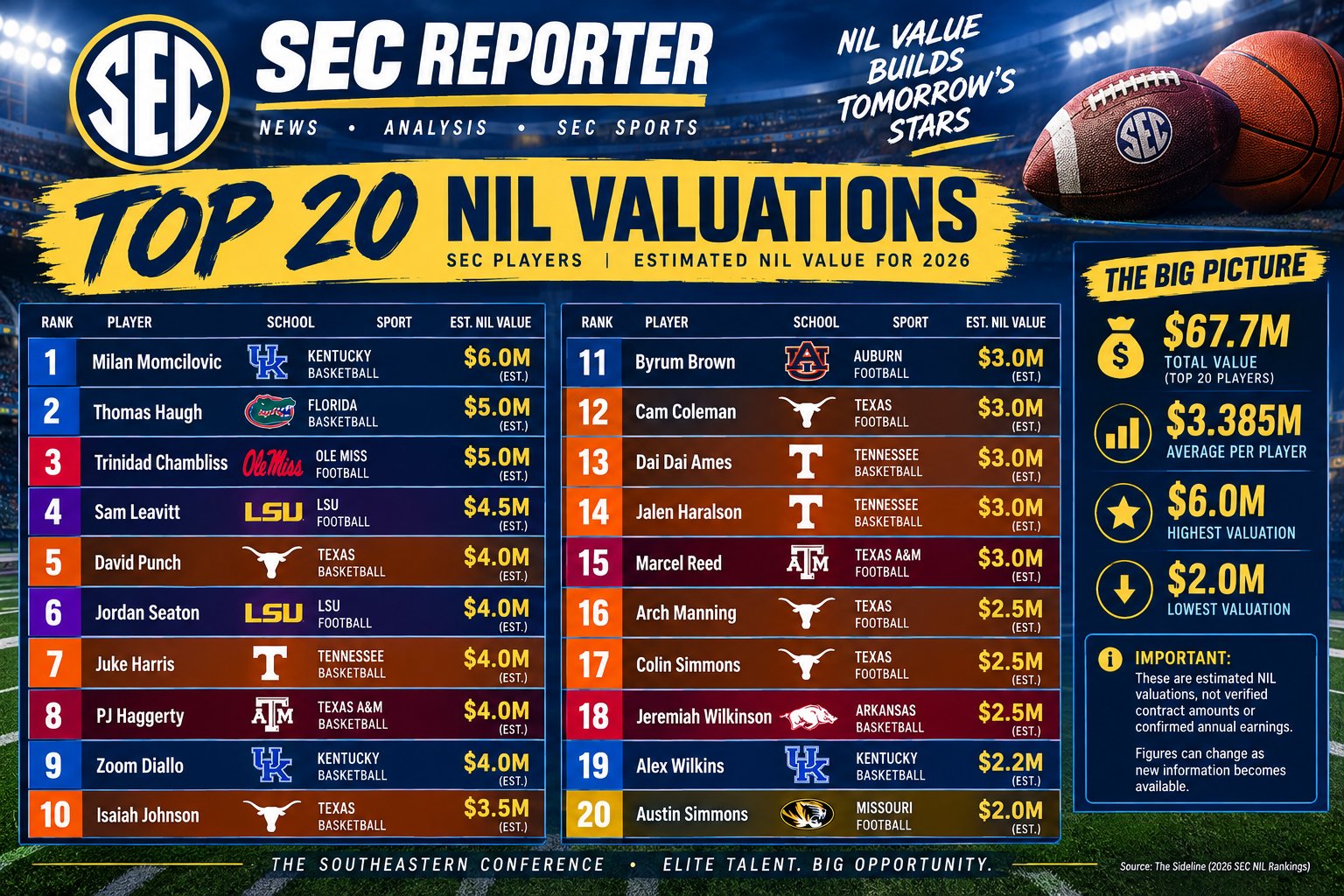
The SEC's Top 20 NIL Valuations
| Rank | Player | School | Sport | Estimated NIL value |
|---|---|---|---|---|
| 1 | Milan Momcilovic | Kentucky | Basketball | $6.0 million |
| 2 | Thomas Haugh | Florida | Basketball | $5.0 million |
| 3 | Trinidad Chambliss | Ole Miss | Football | $5.0 million |
| 4 | Sam Leavitt | LSU | Football | $4.5 million |
| 5 | David Punch | Texas | Basketball | $4.0 million |
| 6 | Jordan Seaton | LSU | Football | $4.0 million |
| 7 | Juke Harris | Tennessee | Basketball | $4.0 million |
| 8 | PJ Haggerty | Texas A&M | Basketball | $4.0 million |
| 9 | Zoom Diallo | Kentucky | Basketball | $4.0 million |
| 10 | Isaiah Johnson | Texas | Basketball | $3.5 million |
| 11 | Byrum Brown | Auburn | Football | $3.0 million |
| 12 | Cam Coleman | Texas | Football | $3.0 million |
| 13 | Dai Dai Ames | Tennessee | Basketball | $3.0 million |
| 14 | Jalen Haralson | Tennessee | Basketball | $3.0 million |
| 15 | Marcel Reed | Texas A&M | Football | $3.0 million |
| 16 | Arch Manning | Texas | Football | $2.5 million |
| 17 | Colin Simmons | Texas | Football | $2.5 million |
| 18 | Jeremiah Wilkinson | Arkansas | Basketball | $2.5 million |
| 19 | Alex Wilkins | Kentucky | Basketball | $2.2 million |
| 20 | Austin Simmons | Missouri | Football | $2.0 million |
Source: The Sideline's 2026 SEC NIL valuation rankings. Figures are estimates of NIL market value, not independently verified contract totals or confirmed annual earnings. Rankings and estimates can change.
Basketball Makes a Big Statement
One of the most interesting takeaways from the rankings is the prominence of men's basketball.
Kentucky forward Milan Momcilovic tops the list with an estimated NIL value of $6 million, while Florida's Thomas Haugh follows at $5 million. Several other basketball players, including Texas' David Punch, Tennessee's Juke Harris and Texas A&M's PJ Haggerty, carry estimated valuations of $4 million.
The numbers challenge the assumption that the SEC's biggest NIL figures belong exclusively to football players.
Basketball rosters are smaller, making individual players especially important to a team's success. A high-impact player can influence a program's postseason prospects, visibility and recruiting momentum. In a competitive transfer market, that can translate into substantial financial interest.
Still, a valuation does not establish what any particular player actually receives. Without a disclosed agreement or reliable reporting on compensation, the figures should be understood as market estimates.
Football's Quarterback Economy
Football remains a major force in the SEC's NIL market, particularly at quarterback.
Ole Miss quarterback Trinidad Chambliss is valued at $5 million, while LSU quarterback Sam Leavitt is estimated at $4.5 million. Auburn's Byrum Brown and Texas A&M's Marcel Reed are each valued at $3 million.
Those figures illustrate the perceived financial importance of a quarterback in the modern college game.
Quarterbacks command attention from fans, national media, sponsors and potential business partners. They can become the public face of a program, and their performance can influence a team's entire season. Established production, recruiting pedigree, transfer-market demand and national visibility can all contribute to an athlete's estimated market value.
Offensive tackle Jordan Seaton, valued at $4 million, is another notable name on the list. His presence highlights that substantial valuations are not limited to quarterbacks or skill-position players.
However, these estimates should not be interpreted as proof that every player listed has signed a contract for the stated amount.
Texas Has Multiple High-Value Assets
Texas appears repeatedly in the rankings, with basketball player David Punch and football players Cam Coleman, Arch Manning and Colin Simmons among the listed athletes.
That concentration is noteworthy. Texas operates in one of college sports' largest commercial markets, with a prominent athletic brand, a large fan base and extensive opportunities for corporate partnerships.
The Longhorns' position also illustrates an important distinction: a school's ability to attract valuable athletes does not mean every athlete has the same compensation structure. Individual arrangements can vary considerably according to sport, role, experience, performance and commercial appeal.
Other SEC programs have multiple entries as well. Kentucky has three basketball players in the top 20, while Tennessee also features several highly valued basketball athletes.
NIL Is No Longer One Simple Number
There is another reason fans should approach these rankings carefully: the financial structure of college athletics has changed.
Since the implementation of the post-House v. NCAA settlement framework in 2025, participating schools have been able to provide direct athlete revenue-sharing compensation within applicable limits. Third-party NIL agreements remain a separate category, subject to the relevant rules and reporting requirements.
That means several different financial figures can be discussed under the broad heading of college athlete compensation:
-
Third-party NIL deals: Sponsorships, endorsements, licensing and other commercial agreements.
-
School revenue sharing: Direct compensation provided by an institution under the applicable framework.
-
Collective-related arrangements: Deals or support associated with organizations connected to a school's athlete-support ecosystem.
-
Estimated NIL market value: A third-party estimate of an athlete's potential commercial value.
These categories should not automatically be added together. Some estimates may already reflect overlapping assumptions, and a market valuation is not necessarily a measure of actual earnings.
For fans comparing schools, the distinction matters. A headline number can generate attention, but it does not tell the whole story of a player's guaranteed compensation, incentives, contract duration or endorsement obligations.
What This Means for the SEC
The larger lesson is that NIL has become part of the SEC's competitive landscape across multiple sports.
Financial resources can help programs attract transfers, retain established players and compete for elite recruits. But money alone does not guarantee success. Coaching, development, roster fit, health, chemistry and performance remain essential.
For fans, the challenge is separating what is known from what is estimated. Private agreements make a definitive ranking of actual athlete earnings difficult, and publicly available figures do not provide a complete accounting of every player's compensation.
The current estimates nevertheless offer a useful snapshot of where the market believes some of the SEC's most valuable athletes stand.
The Bottom Line
Kentucky's Milan Momcilovic leads this particular SEC-wide NIL valuation list at an estimated $6 million, with Florida's Thomas Haugh and Ole Miss quarterback Trinidad Chambliss close behind at $5 million.
The rankings also show how the NIL conversation has expanded beyond football, with basketball players representing a significant portion of the top 20.
One point deserves emphasis: these are estimated NIL valuations, not a verified list of the SEC's 20 highest-paid players. Until more individual agreements and compensation details become public, the exact order of actual earnings will remain uncertain.
For SEC fans, one thing is clear: following the money has become another part of following the game.
Sources and methodology: The Sideline's overall NIL rankings, SEC men's basketball rankings, and On3 college football NIL valuations. Figures reflect third-party estimates available in October 2026 and may change as public reporting and athlete information are updated.